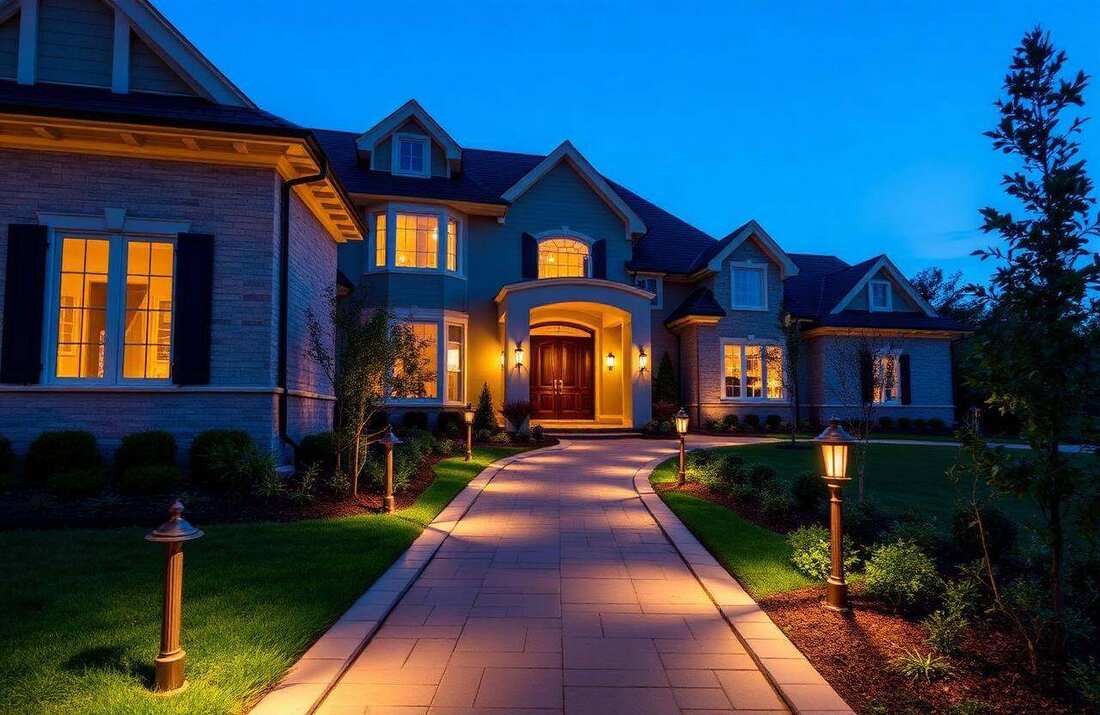
Lighting the front facade of a home is the single highest-leverage design decision in any residential outdoor lighting project. A well-lit facade defines how the entire property reads from the street, sets the visual hierarchy for the rest of the landscape lighting, and adds more perceived value to the home than any other category of outdoor lighting.
The techniques are simple to describe and difficult to execute. This guide covers the three primary facade lighting techniques — up-lighting, grazing, and washing — and how to combine them for a designed result rather than an accidental one.
The Three Core Techniques
**Up-lighting** places narrow-beam fixtures at the base of the facade, aimed up the wall to highlight vertical architectural features (columns, pilasters, gables, dormers). It creates strong vertical lines and dramatic shadow play. Best for homes with significant vertical architecture — colonials, traditional brick, columned entries.
**Grazing** places fixtures very close to the wall (6–12 inches out), aimed straight up the surface. It dramatizes wall texture by raking light across the surface at a shallow angle, throwing every brick joint, stone face, or stucco texture into sharp relief. Best for homes with strong textural materials — stacked stone, brick, board-and-batten siding, rough stucco.
**Washing** places wider-beam fixtures 18–36 inches out from the wall, aimed up the surface to produce broad, even illumination. It minimizes shadow and creates a clean, modern glow on smooth surfaces. Best for homes with smooth or simple facades — modern stucco, painted siding, glass.
Most residential facades benefit from a combination of all three. The mistake is choosing one and using it everywhere.
When to Up-Light: Identify the Verticals
Up-lighting works when the facade has strong vertical elements worth emphasizing. Walk the property in daylight and identify everything that draws the eye vertically — entry columns, pilasters flanking the front door, the gable peak above the garage, dormers, chimneys. Each of those is an up-light candidate.
Fixture choice: narrow-beam (10–24 degree) brass spot lights at 4–7 watts each, placed 12–18 inches from the wall, aimed straight up the vertical element. For columns, one fixture on each visible side. For pilasters, one fixture aimed up between the pilaster and the wall. For gables, one fixture at each base of the gable framing.
Avoid up-lighting flat sections of wall with no vertical detail. The light has nothing to do once it gets there, and you end up with a generic 'wash' that would be better executed with a wider-beam fixture and a different technique.
When to Graze: Highlight Texture
Grazing turns ordinary stone or brick into a dominant nighttime feature. The technique requires the fixture to be very close to the wall — 6–12 inches — so light rakes across the surface at a shallow angle, casting tiny shadows from every irregularity.
This is the technique that makes stacked stone columns and brick facades look stunning at night. It also brutally exposes uneven stucco, sloppy mortar joints, and patchy paint, so confirm the wall actually looks good in raking light before committing.
Fixture choice: medium-beam (24–38 degree) brass linear or spot fixtures at 3–5 watts each, spaced 4–6 feet apart along the base of the wall. Hide the fixtures in mulch or low groundcover so only the lens shows. For very tall walls (over 12 feet), add a second row of fixtures mounted higher (under a roof overhang or on an upper-floor ledge) aimed downward to graze the upper portion.
When to Wash: Smooth, Modern Surfaces
Washing produces broad even illumination across smooth facades. It's the right technique for modern homes, painted stucco, smooth siding, and any surface where you want even brightness rather than dramatic shadow play.
Fixture choice: wide-beam (38–60 degree) brass spot fixtures at 4–6 watts each, placed 24–36 inches out from the wall, spaced 6–10 feet apart along the base. The wider beam and greater fixture distance produce a more diffuse, even result than grazing.
Color Temperature for Facades
2700K warm white is correct for almost every residential facade. It reads warm on brick, natural on stone, clean on stucco, and inviting on painted siding. 3000K starts to look slightly cool on warm-toned brick and stone. Anything above 3000K should be reserved for specific architectural effects, almost never for residential.
The single exception is white-painted modern architecture, where some designers prefer 3000K or even 3500K to emphasize the crispness of the white walls. Even there, 2700K is usually the safer default and reads more inviting from the street.
Hiding the Fixtures
Facade lighting fixtures should be invisible from the street. The only thing the viewer should see is the lit facade, not the lights doing the lighting.
Bury fixtures in mulch or low groundcover so only the lens shows. Aim fixtures so the lens points away from the primary viewing angle. For grazing applications, the fixture is so close to the wall that even minimal groundcover (or a low boxwood or liriope) hides it completely.
If the foundation planting is bare (newly installed, or a contemporary design with gravel beds), use well lights — fully recessed fixtures — so nothing protrudes above grade.
Common Mistakes
The most common facade lighting mistake is uniform up-lighting — placing identical wide-beam fixtures every 6 feet along the entire front of the house, creating a flat, undifferentiated glow. The result is the lighting equivalent of fluorescent office lighting: technically functional, completely characterless.
The second most common mistake is over-lighting. A facade lit too brightly washes out the rest of the landscape lighting and looks aggressive rather than welcoming. Total facade wattage should be in proportion to the rest of the system — usually 30–50% of total system wattage, not 80%.
What Facade Lighting Costs
Facade lighting for a typical 40-foot residential facade in 2026 runs $3,500–$7,500 installed for 10–18 fixtures, depending on technique mix and fixture quality. Two-story homes with multiple gables and architectural detail can easily run $8,000–$15,000 for the facade alone — and on the right home, it's the best $10,000 you'll spend on the entire property.
Key takeaways
- The Three Core Techniques
- When to Up-Light: Identify the Verticals
- When to Graze: Highlight Texture
- When to Wash: Smooth, Modern Surfaces
- Color Temperature for Facades
Frequently asked
- What's the takeaway from "Architectural Facade Lighting: Up-Lighting and Grazing Your Home"?
- How to light the front facade of a home with up-lighting, grazing, and washing techniques — fixture placement, beam angles, and the design rules that make a house look architectural at night.
- Do you install outdoor lighting nationwide?
- Yes — across 30+ states and growing. Browse the locations directory for your city.
Related services
Featured service areas
Keep reading
How to Choose Landscape Lighting Fixtures That Last 10+ Years
A homeowner's guide to picking outdoor landscape lighting fixtures, transformers, bulbs, and wiring that survive a decade outside without fading, corroding, or failing.
Permanent Holiday Lighting Cost, Pros and Cons (2025 Buyer's Guide)
Permanent holiday lighting (Trimlight, Jellyfish, Everlights) explained: real installation cost, how it works, warranty red flags, and the questions to ask before you sign.