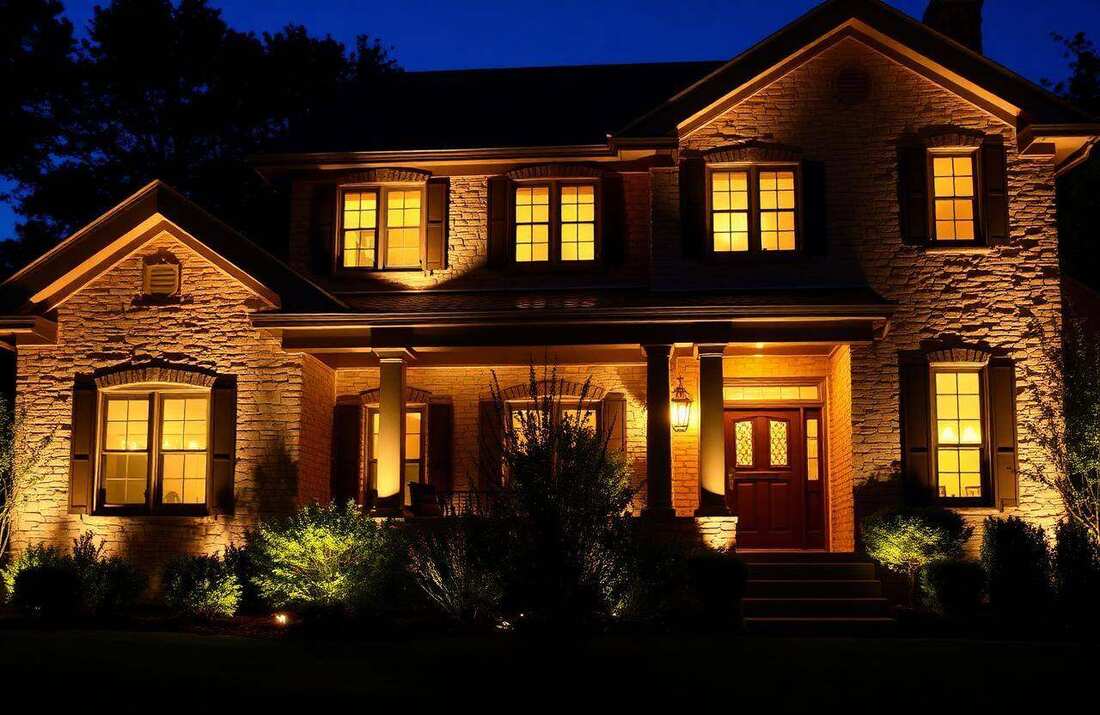
The front entrance is where every visitor forms their first impression of a home after dark. It's also one of the most consistently under-designed lighting zones on residential properties. Most homes have a single oversized or undersized porch fixture, a too-bright doorbell light, and nothing else — leaving the entrance feeling either harsh or dim depending on which mistake was made.
A well-designed front entrance combines four lighting elements: the primary porch fixture, the door surround lighting, the path approach, and the address marker. Get all four right and the entrance is warmly inviting, well-lit for safety, and clearly visible from the street.
The Primary Porch Fixture: Size It Correctly
The single most common front porch lighting mistake is fixture sizing. Most porch lanterns are dramatically undersized for the home — the fixture that looked right on the showroom wall is half the size it should be when mounted next to a real front door at real scale.
The right sizing rule: the porch fixture should be roughly 1/3 the height of the front door for fixtures flanking the door, and roughly 1/4 the height of the door for fixtures mounted above the door. For a standard 80-inch front door, that means flanking fixtures should be 24–28 inches tall and overhead fixtures should be 18–22 inches tall.
For a more dramatic effect on larger or grander entrances, fixtures can be sized up to 1/2 the door height. For a typical 80-inch door, that's a 36–40 inch flanking lantern — substantial, but appropriate for two-story homes with strong entry architecture.
Almost everyone errs on the small side. When in doubt, go up a size.
One Fixture or Two? Use the Architecture
Two flanking fixtures (one on each side of the door) work for symmetrical entries with enough wall space between the door and the nearest wall edge for proper proportioning. Single overhead fixtures work for entries without flanking wall space, or for asymmetric architectural designs where flanking fixtures would feel forced.
The rule: if both flanking positions have at least 12 inches of wall between the fixture edge and the door frame or any other architectural element, two flanking fixtures look intentional. If either side is tighter than that, use a single overhead fixture instead.
For very large entries (oversized doors, double doors, grand porticos), combine both: two large flanking lanterns plus a smaller overhead pendant. This is the formal Georgian / Federal approach and looks beautiful when the architecture supports it.
Brightness and Color Temperature
Porch fixtures should produce 600–1500 lumens per fixture for a typical residential front entrance. Lower than 600 lumens reads dim and uninviting; higher than 1500 lumens reads aggressive and washes out guests' faces in unflattering directional light.
Color temperature is 2700K warm white. The single most common front entrance lighting mistake after fixture sizing is using 3500K or 4000K bulbs in the porch fixture. The cool color makes the entrance feel commercial and unwelcoming — like a hotel chain lobby rather than a home.
Use dimmable LEDs and a dimmer (or smart dimmer) so the brightness can be tuned for different times. A typical setting is 70–80% for evening hours and 40–50% for late night when only the door area needs gentle illumination.
Door Surround Lighting
Beyond the primary porch fixture, the door surround often benefits from supplementary lighting. The most common addition is recessed lighting in the porch ceiling above the door — usually a single 3–4 inch downlight aimed at the door surface itself, producing soft fill light that illuminates the door and makes the entry feel substantial.
For doors with significant architectural surround (transoms, sidelights, decorative trim), grazing the surround with a small directional fixture can dramatically emphasize the architecture. Use a small wall-grazing fixture aimed up at the transom or across the sidelight, separately dimmable from the primary porch fixture.
The Path Approach
The walkway from driveway to front door is the second half of the entrance experience. If the walkway is dark, visitors walk through darkness to reach a bright porch, which feels uncomfortable and creates a safety hazard. The path approach lighting should provide enough illumination to walk safely, plus enough visual interest to feel welcoming.
For most front walkways, this means 4–6 path lights spaced 8–10 feet apart, staggered on alternating sides. Match the path light color temperature (2700K) to the porch fixtures for a unified visual feel.
For longer walkways or walkways with elevation changes, add bollard lights or step lights at the transitions and grade changes. Don't try to over-light the path — the goal is enough illumination to feel safe and intentional, not enough to fully illuminate the walking surface.
The Address Marker
The house number is the third-most-important entrance lighting element and the most frequently forgotten. Without illuminated address numbers, visitors can't find the house, delivery drivers can't find the house, and emergency responders can't find the house. Every front entrance needs visible address numbers from the street at night.
Two approaches work: illuminated address number plaques (numbers backlit or edge-lit with built-in LEDs) or non-illuminated numbers lit by a dedicated small fixture aimed at them. The illuminated plaque approach is cleaner aesthetically; the dedicated-fixture approach works better with traditional architecture where backlit numbers would look out of place.
Either way, the address should be readable from the street at night. Walk to the curb after dark and verify. Most properties fail this test.
The Layered Effect
When all four elements work together — porch fixture, door surround, path approach, address marker — the entrance reads as a welcoming sequence rather than a single bright spot. Visitors arrive at the curb and see the address clearly. They walk a softly-lit path that feels intentional. They approach a door surround that's warmly framed. They arrive at a porch lit at appropriate brightness for face-to-face conversation.
This is the experience of a designed entrance. It costs $1,500–$4,000 above the cost of a single porch fixture, depending on how many path lights are needed and what address marker approach is chosen. For a feature that defines every visitor's first impression of the home, that investment returns disproportionately at every dinner party, every delivery, and every showing.
Avoid These Common Mistakes
- Single tiny porch fixture on a grand front door (massive scale mismatch) - Cool-white porch bulb (makes the entry feel commercial) - Bright security floodlight aimed at the porch (washes out the porch fixture and looks defensive) - Dark walkway with bright porch (creates uncomfortable contrast and tripping hazard) - Unlit or invisible address numbers (the entrance fails its first job) - Identical brightness on porch fixture day and night (use a dimmer; the right brightness varies)
Each of these is cheap to fix individually. Most front entrances have at least two of them at once.
Key takeaways
- The Primary Porch Fixture: Size It Correctly
- One Fixture or Two? Use the Architecture
- Brightness and Color Temperature
- Door Surround Lighting
- The Path Approach
Frequently asked
- What's the takeaway from "Lighting a Front Entrance That Welcomes Guests"?
- How to design front entrance lighting that welcomes visitors and improves safety — porch fixture sizing, layered approach, and the design rules for a great first impression.
- Do you install outdoor lighting nationwide?
- Yes — across 30+ states and growing. Browse the locations directory for your city.
Related services
Featured service areas
Keep reading
How to Choose Landscape Lighting Fixtures That Last 10+ Years
A homeowner's guide to picking outdoor landscape lighting fixtures, transformers, bulbs, and wiring that survive a decade outside without fading, corroding, or failing.
Permanent Holiday Lighting Cost, Pros and Cons (2025 Buyer's Guide)
Permanent holiday lighting (Trimlight, Jellyfish, Everlights) explained: real installation cost, how it works, warranty red flags, and the questions to ask before you sign.