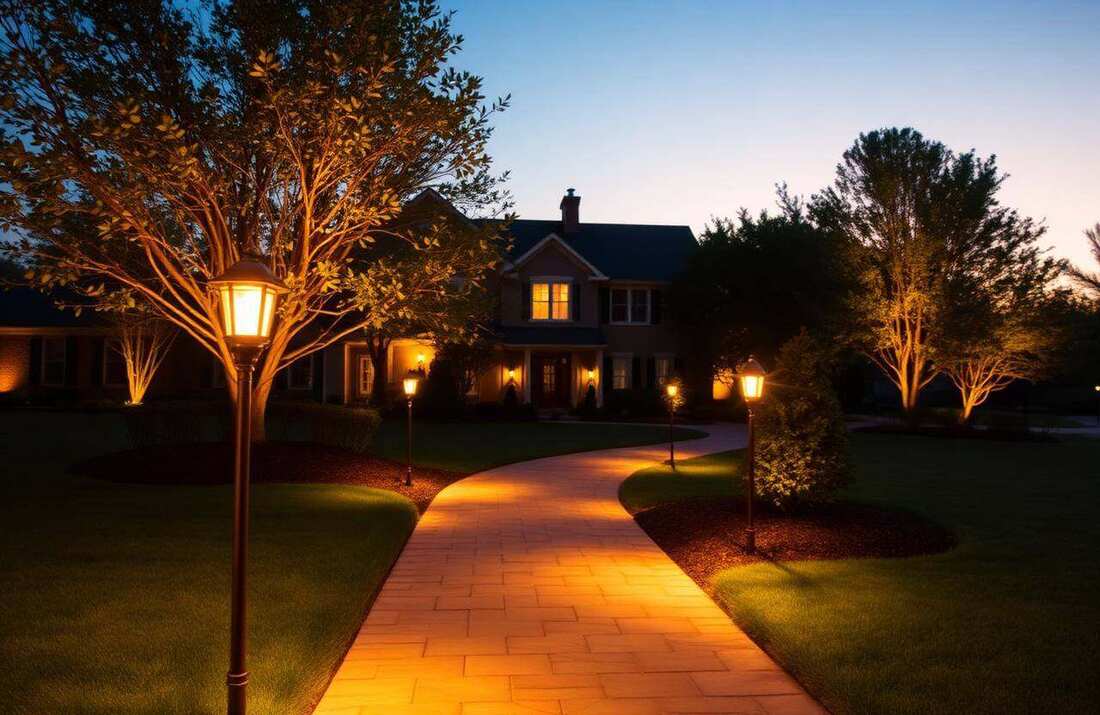
Hiring a landscape lighting designer is harder than it should be. The category attracts a wide range of contractors, from genuine designers who treat each property as a custom project to handymen running kits as side jobs. The price difference between the best and worst can be 3x; the quality difference can be 10x. And almost nothing on a basic Google search distinguishes the two.
This guide walks through what to ask, what to verify, and what to avoid when hiring a landscape lighting designer in 2026. Following this process consistently filters out the bad actors and lands you with someone whose work will outlast every other landscaping investment on the property.
Step 1: Get Three Quotes, From Three Different Tiers
Always get at least three quotes for any landscape lighting project over $3,000. More importantly, get them from three different tiers of contractor:
- **One quote from a low-cost installer** (someone working out of a pickup truck, running kits, advertising on Facebook Marketplace or Nextdoor) - **One quote from a mid-tier company** (3–10 person crew, real office, basic website, 2–5 years in business) - **One quote from a premium designer** (10+ person company, named principal designer, portfolio of past work, 10+ years in business, IES or LIA membership)
You will see prices vary 2–3x across these three tiers. This is normal and tells you what you need to know — the cheap quote is for kit parts and rushed install; the premium quote is for custom design and quality hardware. The right answer for most properties is the mid-tier or premium quote, not the cheap one. The cheap one looks attractive on paper and costs more over a decade.
Step 2: Verify These Five Things About Every Contractor
Before any contractor visits the property, verify each of these online:
**1. Business license and insurance.** Every state requires landscape lighting contractors to carry general liability insurance, and most require workers' compensation if they have employees. Ask for proof of both, in writing. A contractor without these is a liability risk to you if anyone is injured on the property.
**2. Years in business.** Check the state business registration (Secretary of State website in most states) for the date the company was incorporated. Cross-reference with the contractor's claimed history. Companies under 3 years old can absolutely do quality work but carry higher risk on long warranty periods.
**3. Online reviews across multiple platforms.** Check Google, Yelp, Facebook, and Angi. Look for reviews that mention specific projects (custom designs, complex installs) rather than generic '5 stars great service' reviews. Verified bad reviews are more informative than verified good reviews — quality contractors handle disputes professionally.
**4. Portfolio of past work.** Quality designers have a portfolio of past residential projects with night photography. Visit their website and look for at least 10–20 example projects. If the only photos are stock shots or the same 3 projects from different angles, that's a sign of limited actual experience.
**5. Manufacturer relationships.** Quality landscape lighting designers are authorized dealers or installers for at least one premium manufacturer (FX Luminaire, Kichler Pro, Unique Lighting, VOLT Pro). Authorization usually requires training, minimum purchase volumes, and ongoing certification. Verify by checking the manufacturer's 'find a dealer' page.
Step 3: The On-Site Walkthrough — What Quality Designers Do
When the contractor visits the property for a quote, watch what they do. Quality designers:
- Walk the entire property, not just the front yard - Ask about how you use the property (entertaining, daily routine, security concerns, future plans) - Identify the focal features they'd light (specific trees, facade elements, hardscape) and explain why - Talk about fixture types and techniques, not just fixture counts - Mention the night design walk as part of the install process - Ask about your color temperature preference (and recommend 2700K) - Discuss control options (timer, smart home integration, dimming) - Quote a specific fixture model, not 'we use a variety of fixtures' - Provide a written warranty separated into fixture, LED, transformer, and labor categories - Take 30–60 minutes for the walkthrough, not 10
Lower-quality contractors do none of these. They walk the front yard for 10 minutes, count fixtures, multiply by a rate, and hand you a quote. The quote covers fixtures and labor with no design discussion at all.
Step 4: Evaluate the Written Proposal
The written proposal is where you can do most of your final evaluation. A quality proposal includes:
- Fixture-by-fixture spec list with manufacturer and model number for every fixture - Total fixture count broken down by type (path, up-light, down-light, accent, step) - Transformer brand, wattage, and number of voltage taps - Cable gauge and total feet - Connection style explicitly listed as hub-style waterproof (not pierce-point) - Color temperature for every bulb specified in Kelvin - Night design walk explicitly listed as included - Post-install night aim visit explicitly listed as included - Warranty broken down into fixture, LED, transformer, and labor - Payment terms (typically 25–50% deposit, balance on completion; avoid 100%-upfront contractors)
If the proposal lists 'high-quality brass fixtures' without manufacturer / model, or 'industry-leading transformer' without brand, or 'comprehensive warranty' without specific terms, ask for those specifics in writing before signing. Quality contractors provide them without hesitation.
Step 5: Red Flags That Should Eliminate a Contractor
Any one of these is a deal-breaker:
- Won't provide written proof of liability insurance - Quotes 'all fixtures' as a single line item without manufacturer/model - Requires 100% payment before any work begins - Refuses to specify color temperature in Kelvin - Uses pierce-point connectors and defends them when challenged - Won't include a night design walk in the contract - Warranty is 'lifetime' on the fixtures but vague or 1 year on labor - Pressure tactics ('this price is only good today,' 'we have a cancellation we can fit you into') - No portfolio of past residential work - No business license, no Secretary of State registration, or company less than 12 months old
Walk away from any contractor showing any of these. There are too many quality alternatives in any market to take the risk.
Step 6: Reference Calls — The Step Most Homeowners Skip
After narrowing to your top 1–2 candidates, ask each for three past client references and actually call them. This step takes 30 minutes and is the single most informative thing you can do. Ask each reference:
- How long ago was your install? - What does the system look like now? Any failures? - Did the contractor return for the warranty service when called? - Did the night design walk and post-install aim actually happen? - Would you hire them again? If not, what would you do differently? - How did they handle anything that went wrong during the install?
Quality contractors offer references without hesitation. The references tell consistent stories about quality work and good follow-up. Lower-quality contractors deflect on references or provide names of clients who can't be reached.
Step 7: Trust the Process, Not the Charisma
The single biggest mistake homeowners make in hiring landscape lighting designers is going with the contractor they liked the most as a person rather than the contractor whose process and credentials were best. Charisma is not correlated with quality of installation work. Sometimes the best contractor is the quiet engineer-type whose proposal is the most detailed and whose questions are the most precise.
Follow the steps above. Verify what you can verify. Compare proposals on the specifics, not the impressions. Hire the contractor whose process and credentials check out best, not the one with the friendliest personality. The system will last 10+ years; the install relationship lasts a few weeks.
What You're Actually Paying For
When you pay a quality landscape lighting designer versus a cheap installer, you're paying for: design (the right fixture, in the right spot, with the right beam angle), hardware (brass instead of aluminum, hub connections instead of pierce-points, properly sized transformer), the night design walk, the post-install aim, the warranty coverage that actually works when something fails, and the maintenance relationship that keeps the system looking right for a decade.
Every one of these is worth real money. The price difference between a $4,000 quote and a $10,000 quote on the same yard is mostly the price difference between getting all of these and getting none of them.
Key takeaways
- Step 1: Get Three Quotes, From Three Different Tiers
- Step 2: Verify These Five Things About Every Contractor
- Step 3: The On-Site Walkthrough — What Quality Designers Do
- Step 4: Evaluate the Written Proposal
- Step 5: Red Flags That Should Eliminate a Contractor
Frequently asked
- What's the takeaway from "How to Hire a Landscape Lighting Designer (and Avoid Bad Installers)"?
- A complete guide to hiring a quality landscape lighting designer in 2026 — what to ask, what to verify, red flags to avoid, and how to evaluate proposals.
- Do you install outdoor lighting nationwide?
- Yes — across 30+ states and growing. Browse the locations directory for your city.
Related services
Featured service areas
Keep reading

How to Choose Landscape Lighting Fixtures That Last 10+ Years
A homeowner's guide to picking outdoor landscape lighting fixtures, transformers, bulbs, and wiring that survive a decade outside without fading, corroding, or failing.
Permanent Holiday Lighting Cost, Pros and Cons (2025 Buyer's Guide)
Permanent holiday lighting (Trimlight, Jellyfish, Everlights) explained: real installation cost, how it works, warranty red flags, and the questions to ask before you sign.