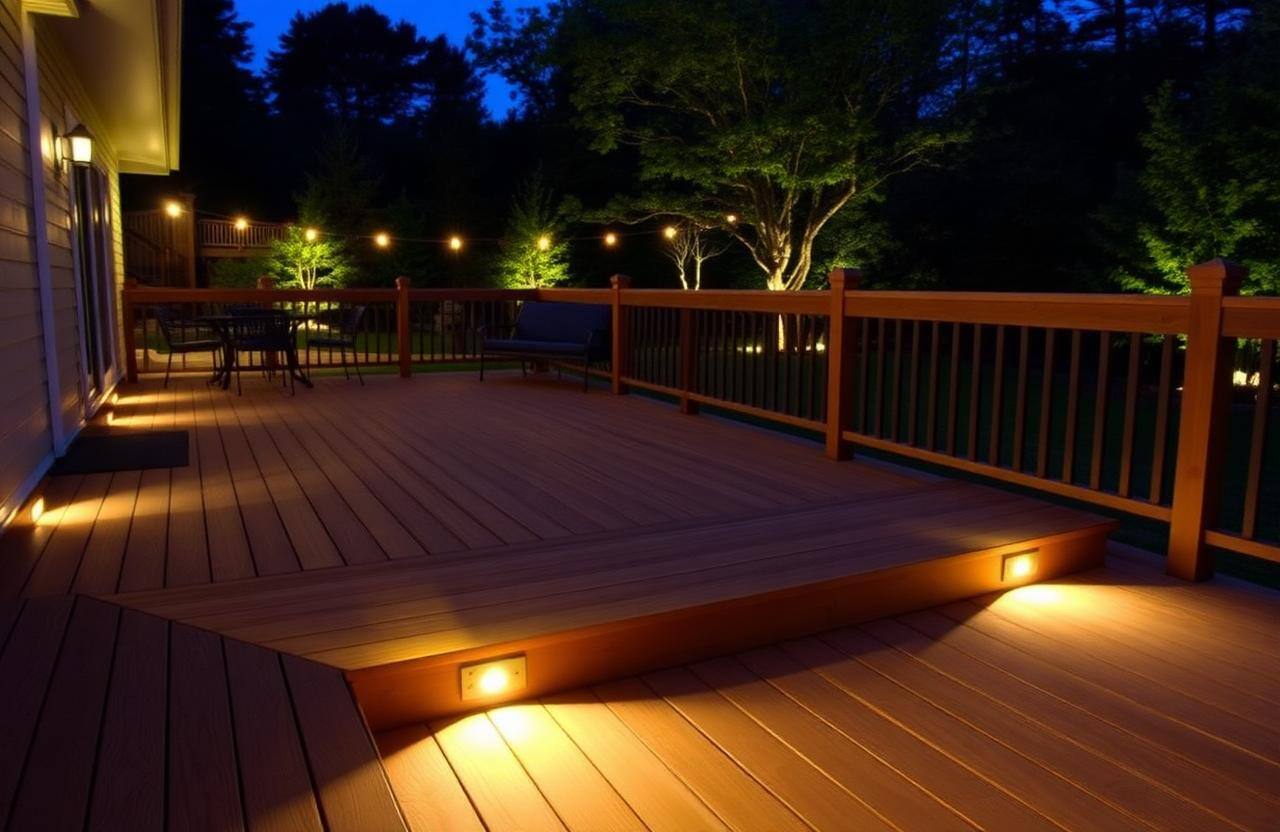
Almost every outdoor lighting decision a homeowner makes comes down to one question: low-voltage 12V or line-voltage 120V? The two systems look identical from the curb at night, but they're fundamentally different in cost, safety, flexibility, and code requirements. Picking the wrong one wastes thousands of dollars and creates a system you'll fight for years.
This guide breaks down exactly when low-voltage landscape lighting wins, when line-voltage outdoor lighting is the smarter answer, and why most well-designed residential properties end up using both.
What's the Actual Difference?
Line-voltage outdoor lighting runs on the same 120-volt power that powers your house. Fixtures wire directly to a standard residential circuit, usually through a weatherproof junction box, and they require a licensed electrician for installation and most modifications.
Low-voltage landscape lighting runs on 12 volts, stepped down from your home's 120V by a transformer mounted on an exterior wall (often near the garage). Because 12V is below the threshold the National Electrical Code considers dangerous to humans, low-voltage systems have far fewer install requirements: no conduit, shallow burial depth, no electrician required for additions, and no permit in most jurisdictions.
That single regulatory difference is why low-voltage dominates residential landscape lighting today.
Why Low Voltage Wins for Most Landscape Lighting
Three reasons low-voltage 12V is the default choice for residential landscape lighting:
**It's genuinely safer.** A 12V cable that's accidentally cut by a shovel creates a small spark and trips the transformer. The same accident on a 120V line can kill someone. That risk delta is why low-voltage systems can be buried just 6 inches deep instead of the 18 inches plus conduit that line-voltage requires.
**It's modular and homeowner-friendly.** Want to add two path lights to an existing 12V run? It's a 30-minute job with hand tools. Want to add them to a 120V circuit? You need an electrician, a permit in most cities, conduit, a new junction box, and probably a half-day of trenching. The total cost difference for a small addition is often 10x.
**The fixture catalog is enormous.** Almost every dedicated landscape lighting brand — FX Luminaire, Kichler, Volt, Vista — designs their best fixtures for 12V first. Line-voltage catalogs are smaller and skew toward commercial-style or builder-grade hardware.
For path lighting, garden lighting, deck lighting, fence lighting, small-tree up-lighting, water feature lighting, and accent lighting, low voltage is almost always the right call.
When Line Voltage Actually Makes More Sense
Line-voltage outdoor lighting wins in three specific scenarios, and pretending otherwise is how installers waste their customers' money.
**Tall tree up-lighting.** Lighting a 40-foot mature oak or pine from the ground takes serious output — usually 35W+ MR16 equivalents or large PAR38 fixtures. 12V systems can do this, but they need heavy 10-gauge cable, large transformers, and careful voltage-drop math. A line-voltage PAR38 in a brass well light is often simpler, brighter, and cheaper to run on big trees.
**Two-story facade washing.** Architectural wall washing on a tall facade benefits from the higher output and longer throw of line-voltage fixtures. The fixture count drops by half or more, which actually makes the install cleaner.
**Very long runs to detached structures.** Lighting a detached garage, pool house, or back fence 200+ feet from the house gets ugly fast on 12V because of voltage drop. Running a single 120V line to a sub-transformer at the destination, then 12V from there, is the right architecture. Pure 12V across that distance requires absurd cable gauges.
The Hybrid System Most Pros Actually Install
Look at any high-end residential outdoor lighting install and you'll almost always see a hybrid system. Line voltage handles the heavy lifters — driveway entrance columns, tall facade washes, the up-lights on the two mature trees flanking the front walk. Low voltage handles everything else — path lights, garden accents, deck step lights, patio bistro string lights, pool deck lights, and the dozen small up-lights tucked into beds.
The transformer for the 12V side gets installed once and powers years of additions. The line-voltage circuits get installed once and rarely change. That separation of concerns is why hybrid systems age so much better than pure-anything systems.
Cost Comparison: 12V vs 120V Installed
For a typical residential front yard with 18 fixtures, a clean low-voltage install runs $3,500–$6,500. The same fixture count and layout in line voltage runs $7,000–$13,000 because of the electrician labor, conduit, deeper trenching, and permitting. The light output looks identical at night.
For a high-output project — say, six 50-watt-equivalent up-lights on tall trees plus facade washing — the cost gap closes or even reverses, because the 12V version needs heavy cable, larger transformers, and more careful design. That's the scenario where line voltage starts to make sense on cost alone.
How to Decide for Your Property
Default to low voltage. Use line voltage only where you have a specific reason — tall trees, big facade washes, or long runs to a detached structure. If a contractor is quoting all line voltage for a basic residential landscape lighting project, get a second bid. If a contractor is quoting all low voltage for a project with three 40-foot oak trees, also get a second bid. The right answer is almost always a hybrid system that uses each technology where it actually wins.
Maintenance and Long-Term Reliability
Low-voltage landscape lighting needs almost no maintenance for the first 5–7 years if it was installed correctly. After that, expect to swap a few LED lamps as the warmest-running fixtures (typically wash lights buried in mulch) age out a year or two ahead of schedule. Hub connections stay sealed for the life of the system. Transformers run silent on a 70% load and rarely need attention.
Line-voltage outdoor lighting is similarly low-maintenance once installed, but repairs are dramatically more expensive when they're needed. A failed line-voltage fixture is an electrician call and often a permit; a failed low-voltage fixture is a 20-minute swap with a screwdriver. Multiply that across a 15-year system life and the maintenance gap widens further in low-voltage's favor for ordinary residential use.
Key takeaways
- What's the Actual Difference?
- Why Low Voltage Wins for Most Landscape Lighting
- When Line Voltage Actually Makes More Sense
- The Hybrid System Most Pros Actually Install
- Cost Comparison: 12V vs 120V Installed
Frequently asked
- What's the takeaway from "Low Voltage vs Line Voltage Outdoor Lighting: Which One to Use"?
- When to choose 12V low-voltage landscape lighting and when 120V line-voltage outdoor lighting is the better answer, with real cost, safety, and design tradeoffs.
- Do you install outdoor lighting nationwide?
- Yes — across 30+ states and growing. Browse the locations directory for your city.
Related services
Featured service areas
Keep reading

How to Choose Landscape Lighting Fixtures That Last 10+ Years
A homeowner's guide to picking outdoor landscape lighting fixtures, transformers, bulbs, and wiring that survive a decade outside without fading, corroding, or failing.
Permanent Holiday Lighting Cost, Pros and Cons (2025 Buyer's Guide)
Permanent holiday lighting (Trimlight, Jellyfish, Everlights) explained: real installation cost, how it works, warranty red flags, and the questions to ask before you sign.