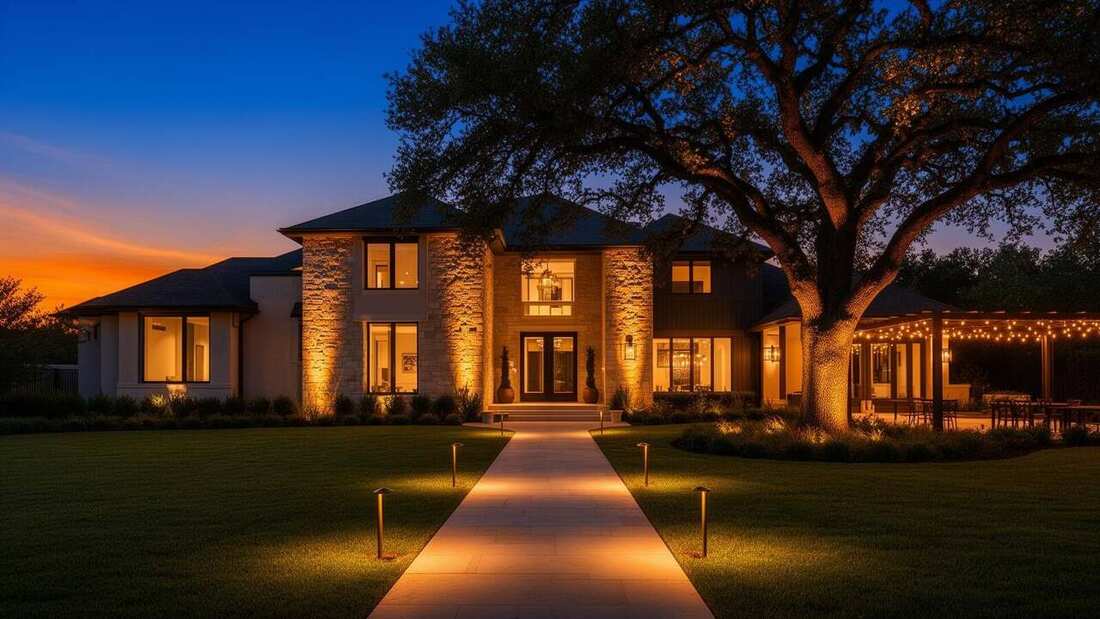
Most residential outdoor lighting installs in the U.S. share the same handful of mistakes. They show up in DIY projects, big-box-kit installs, and even in some professionally-quoted systems where the installer is cutting corners. The good news: most of these mistakes are cheap to fix once you know what you're looking at.
Here are the ten most common outdoor lighting mistakes we see on residential properties, ranked by how badly each one damages the final result.
1. Cool-White LEDs (4000K and Above)
The single most common mistake is using cool-white LEDs outdoors. 4000K and above looks like a parking lot, a gas station, or a commercial property — never a home. It makes brick look gray, mulch look bluish, foliage look unhealthy, and the entire property feel institutional.
Fix: replace every bulb with 2700K warm-white LEDs. The bulbs are usually the same price as cool-white versions and the visual upgrade is immediate. This single change fixes more bad outdoor lighting installs than any other intervention.
2. Runway Path Lighting
Identical path lights spaced 6 feet apart on both sides of a walkway, directly across from each other. The eye reads it as institutional, the brain reads it as 'airport.' Symmetry that looks right on a drawing reads as artificial at night.
Fix: pull every other fixture and stagger the remaining ones at 8–10 foot intervals on alternating sides. You'll use half the fixtures and the walkway will look better.
3. Visible Fixtures
You should see the lit landscape, never the lights doing the lighting. The visible bullet light aimed up a tree, the path light glaring directly into your eyes as you approach the front door, the visible glare-source under every shrub — all of those are amateur tells.
Fix: bury fixtures in mulch or low groundcover so only the lens shows, aim fixtures so the lens points away from primary viewing angles, and use shielded fixtures for anything visible.
4. Over-Lighting
The mistake of treating outdoor lighting like indoor lighting — assuming brighter is better. Outdoor lighting works by contrast; pools of soft light separated by softer darkness read as designed and inviting. Bright uniform illumination across the entire property reads as aggressive and washes out every individual feature.
Fix: dim the system. A dimmable transformer with all zones running at 50–70% almost always looks better than the same fixtures at 100%.
5. Pierce-Point Connectors
The pierce-point connector — a small clamp that pushes a spike through the cable insulation to make contact — is the single most common failure point in low-voltage landscape lighting. It corrodes within 2–3 seasons, builds up resistance, and starts taking fixtures offline one by one.
Fix: any system using pierce-point connectors will need its connections rebuilt within 5 years. Replace them now with hub-style waterproof gel-filled connections. It's the highest-ROI maintenance investment you can make.
6. Under-Sized Transformer
Loading a transformer to 90% or 100% of rated capacity makes it run hot, hum, and die in 2–4 years instead of 10. The rule is 70% maximum load. A 300W transformer should never carry more than ~210W of fixtures.
Fix: measure total load and either downsize fixture wattage or upgrade to a larger transformer. A correctly-sized transformer is usually a $300–$600 upgrade and dramatically extends system life.
7. Wrong Beam Angle for Tree Up-Lighting
A 60-degree wide-beam bulb pointed at a 40-foot oak just lights the lower trunk; the light dies before it reaches the canopy. The right beam for tall trees is narrow — 10–24 degrees — so the light actually reaches the upper crown.
Fix: re-bulb each up-light with the right beam angle for tree size. The cost is just the new bulbs and a 5-minute swap per fixture.
8. Identical Wattage Everywhere
Using the same wattage bulb in every fixture, regardless of what each fixture is supposed to do. Path lights, up-lights for small ornamental trees, and up-lights for 60-foot mature oaks all need different wattage. Putting 4-watt bulbs everywhere means under-lighting the big trees; putting 8-watt bulbs everywhere means over-lighting the path.
Fix: vary wattage by purpose. 2–4 watts for path lights, 4–6 watts for small ornamentals, 6–10 watts for medium trees, 10–15+ watts for large mature trees.
9. No Night Aim Visit
Aiming fixtures in daylight using guesswork. The fixture position that looks right in afternoon sun is almost never the right position at night, when light, shadow, and viewing angles all behave differently.
Fix: any quality install should include a post-install night aim visit, where the installer returns after dark and adjusts every fixture in actual operating conditions. If your installer skipped it, hire someone to do it. It's the single biggest determinant of whether a system looks designed.
10. No Maintenance Plan
The slow erosion mistake. Year one the system looks great. Year three it looks worse because trees have grown into up-light fixtures and nobody re-aimed. Year five it looks bad because half the bulbs are dim and nobody replaced them. Year seven it's dark in spots because connections are failing and nobody is doing the annual inspection.
Fix: budget $250–$500 per year for a professional annual or twice-annual service. A maintained system looks good for 10+ years. An unmaintained system looks tired by year four.
The Pattern Behind Every Mistake
Almost every mistake on this list comes from the same root cause: a contractor installing a kit instead of designing a system. Kits use generic fixtures, generic spacing, generic wattage, and skip the night aim and the maintenance plan. They produce systems that work technically but never look designed.
The fix, for any of these mistakes individually, is small. The structural fix is to hire a landscape lighting designer who treats every property as a custom design, specifies fixtures and wattage individually, includes the night aim in the contract, and offers an ongoing service plan. Pay for design once, maintain it properly, and the system will outlast almost every other landscaping investment on the property.
Key takeaways
- 1. Cool-White LEDs (4000K and Above)
- 2. Runway Path Lighting
- 3. Visible Fixtures
- 4. Over-Lighting
- 5. Pierce-Point Connectors
Frequently asked
- What's the takeaway from "10 Outdoor Lighting Mistakes That Kill Curb Appeal"?
- The most common outdoor lighting mistakes in residential installs — from cool-white LEDs to runway path lighting — and how to fix each one without rebuilding the system.
- Do you install outdoor lighting nationwide?
- Yes — across 30+ states and growing. Browse the locations directory for your city.
Related services
Featured service areas
Keep reading
How to Choose Landscape Lighting Fixtures That Last 10+ Years
A homeowner's guide to picking outdoor landscape lighting fixtures, transformers, bulbs, and wiring that survive a decade outside without fading, corroding, or failing.

Permanent Holiday Lighting Cost, Pros and Cons (2025 Buyer's Guide)
Permanent holiday lighting (Trimlight, Jellyfish, Everlights) explained: real installation cost, how it works, warranty red flags, and the questions to ask before you sign.