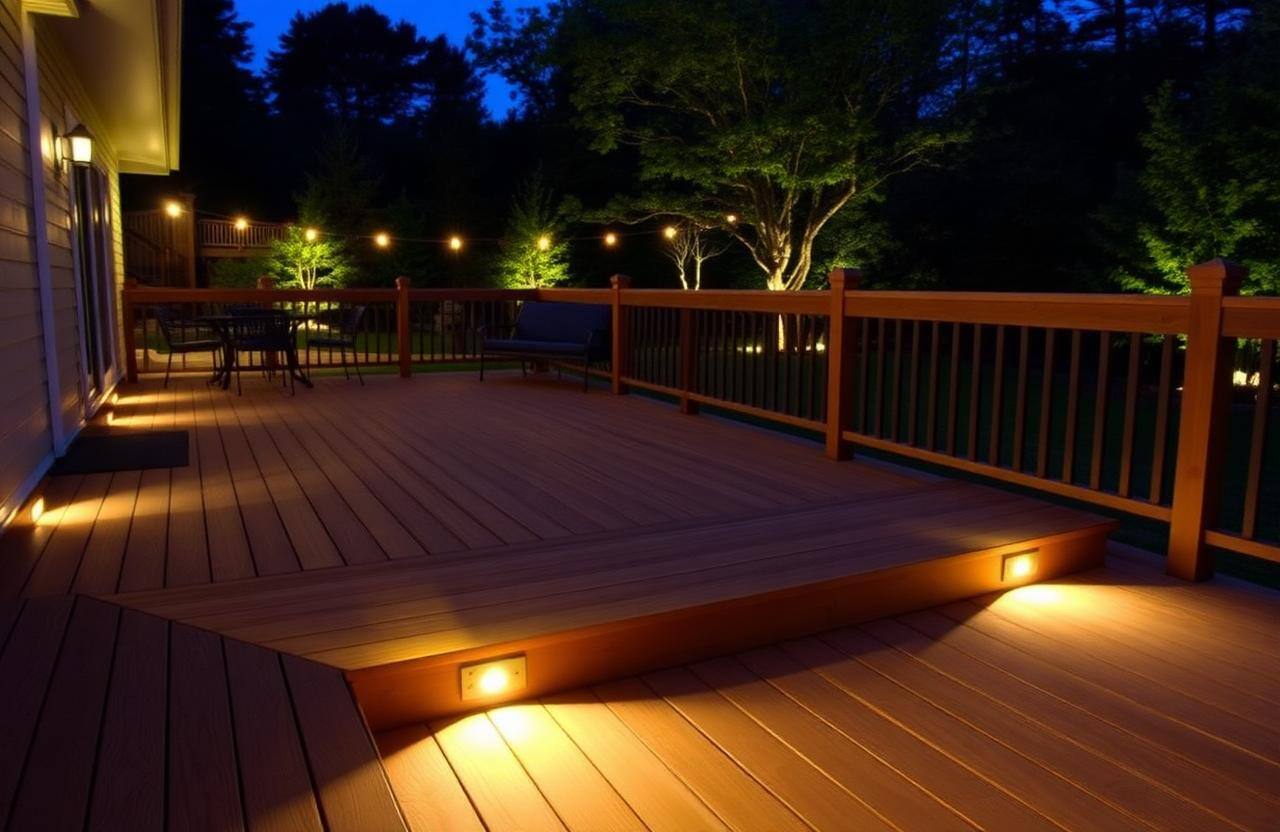
Path lights are the most common outdoor lighting fixture in residential use, and the most commonly misused. Walk down any suburban street at night and you'll see the same mistake again and again: 12 identical path lights spaced six feet apart, marching down both sides of a 30-foot walkway, lit up like an airport runway. It looks terrible, it costs more than it needs to, and it's the result of one wrong assumption — that path lighting is about evenly lighting the path.
It isn't. Good path lighting is about creating overlapping, intentional pools of light that guide the eye and the foot without ever calling attention to the fixtures themselves. Get the spacing right and a walkway needs half as many fixtures and looks twice as good.
The Real Spacing Rule: 8 to 10 Feet, Staggered
For a standard 12–18 inch tall path light with a typical 24-inch beam diameter, the right spacing is 8–10 feet between fixtures, staggered on alternating sides of the walkway. Not parallel. Not matched. Staggered.
Staggered spacing creates overlapping light pools that read as continuous illumination without ever putting two fixtures directly across from each other. Parallel spacing — the runway pattern — does the opposite: it draws the eye to the fixtures themselves and creates harsh dark gaps between every pair.
Tighter than 8 feet apart and the pools overlap so much you've wasted fixtures. Wider than 10 feet and dark gaps appear between pools, which reads unsafe and forces visitors to walk through visible darkness.
Fixture Height Matters as Much as Spacing
Path light height controls beam diameter. A 12-inch fixture throws a roughly 24-inch pool. An 18-inch fixture throws closer to 36 inches. A 24-inch fixture (which most homeowners over-buy) throws nearly 48 inches and washes light onto adjacent beds, which usually looks messy.
Match fixture height to walkway width. A 30-inch wide stepping-stone path needs 12-inch fixtures spaced 8 feet apart. A 4-foot wide formal walkway can handle 18-inch fixtures spaced 10 feet apart. A 6-foot wide entry walk can use 24-inch fixtures spaced 12 feet apart — but at that width you should also be looking at moonlighting from above, not relying on path fixtures alone.
The Number One Mistake: Lining Both Sides Symmetrically
A walkway with path lights on both sides, directly across from each other every 6 feet, will always look like a runway. Always. The symmetry that feels right on a drawing reads as institutional in real life.
Two fixes work. The first is staggered spacing — fixtures on alternating sides, 8–10 feet between any two consecutive lights. The second is one-sided lighting — every fixture on the same side of the path, spaced 6–8 feet apart, letting the beam wash all the way across the walkway. One-sided lighting works especially well when one side of the path has a planting bed and the other side is lawn.
Pure symmetry should be reserved for very formal landscape designs with a strong axial composition (like the approach to a Georgian-style home), and even there it works better with column lights or post lights at major intervals, not path lights every six feet.
Don't Light Every Single Foot of Path
The instinct is to light the full length of every walkway. The reality is that landscape lighting works by contrast — pools of light separated by softer darker stretches read more interesting and more inviting than a continuously lit ribbon.
For a 40-foot walkway, 5 fixtures spaced 8–10 feet apart on a stagger is almost always enough. The eye fills in the gaps automatically because the brain wants to see a continuous path. For a 60-foot walkway, 7 fixtures will outperform 10. Cut the count by 20–30% from your first instinct and the design almost always improves.
Beam Color and Bulb Choice for Path Lights
Always 2700K warm white for path lighting. 3000K reads slightly clinical on mulch and stone. 4000K and above looks like commercial parking-lot lighting, no matter how expensive the fixture.
LED wattage for path lights should be 2–4 watts per fixture. Higher wattage doesn't make the light look better — it just creates hot spots and harsh shadows on the path surface. The right effect is a soft glow that lets you see the path edges clearly without ever feeling like you're standing in direct light.
Special Cases: Curves, Steps, and Tight Spaces
Curved paths need an extra fixture at the apex of every curve. The eye reads a curve as a decision point, and unlit curves feel uncertain at night even when they're perfectly safe.
Steps need dedicated step lights, not path lights. A path light next to a step illuminates the path before and after the step but throws a sharp shadow across the step face itself, which is exactly the spot you need to see. Use a step light recessed into the riser or a small directional fixture from above.
Tight spaces — paths under 30 inches wide, narrow side yards, walkways squeezed between a house and a fence — should use bollard lights or small wall-mounted fixtures rather than ground-mounted path lights. Ground fixtures in tight spaces create tripping hazards and almost always get hit by garden tools.
What Good Path Lighting Costs
Quality path lighting installed in 2026 runs $200–$400 per fixture installed, including the brass or copper fixture, transformer share, cable, hub connection, and aim. A typical 40-foot front walkway needs 5 fixtures and lands at $1,000–$2,000 installed. A 60-foot wraparound walkway with 7 fixtures runs $1,400–$2,800.
That pricing assumes a quality install with proper spacing, fixture choice, and a night aim. The $80-each plastic path light kits from big-box stores can light the same walkway for $400, and the result reads exactly like what you paid for.
Key takeaways
- The Real Spacing Rule: 8 to 10 Feet, Staggered
- Fixture Height Matters as Much as Spacing
- The Number One Mistake: Lining Both Sides Symmetrically
- Don't Light Every Single Foot of Path
- Beam Color and Bulb Choice for Path Lights
Frequently asked
- What's the takeaway from "Path Lighting Spacing Guide: How Far Apart to Place Path Lights"?
- The right distance between outdoor path lights, fixture height, beam spread, and the spacing mistakes that make residential walkways look like a runway.
- Do you install outdoor lighting nationwide?
- Yes — across 30+ states and growing. Browse the locations directory for your city.
Related services
Featured service areas
Keep reading
How to Choose Landscape Lighting Fixtures That Last 10+ Years
A homeowner's guide to picking outdoor landscape lighting fixtures, transformers, bulbs, and wiring that survive a decade outside without fading, corroding, or failing.
Permanent Holiday Lighting Cost, Pros and Cons (2025 Buyer's Guide)
Permanent holiday lighting (Trimlight, Jellyfish, Everlights) explained: real installation cost, how it works, warranty red flags, and the questions to ask before you sign.