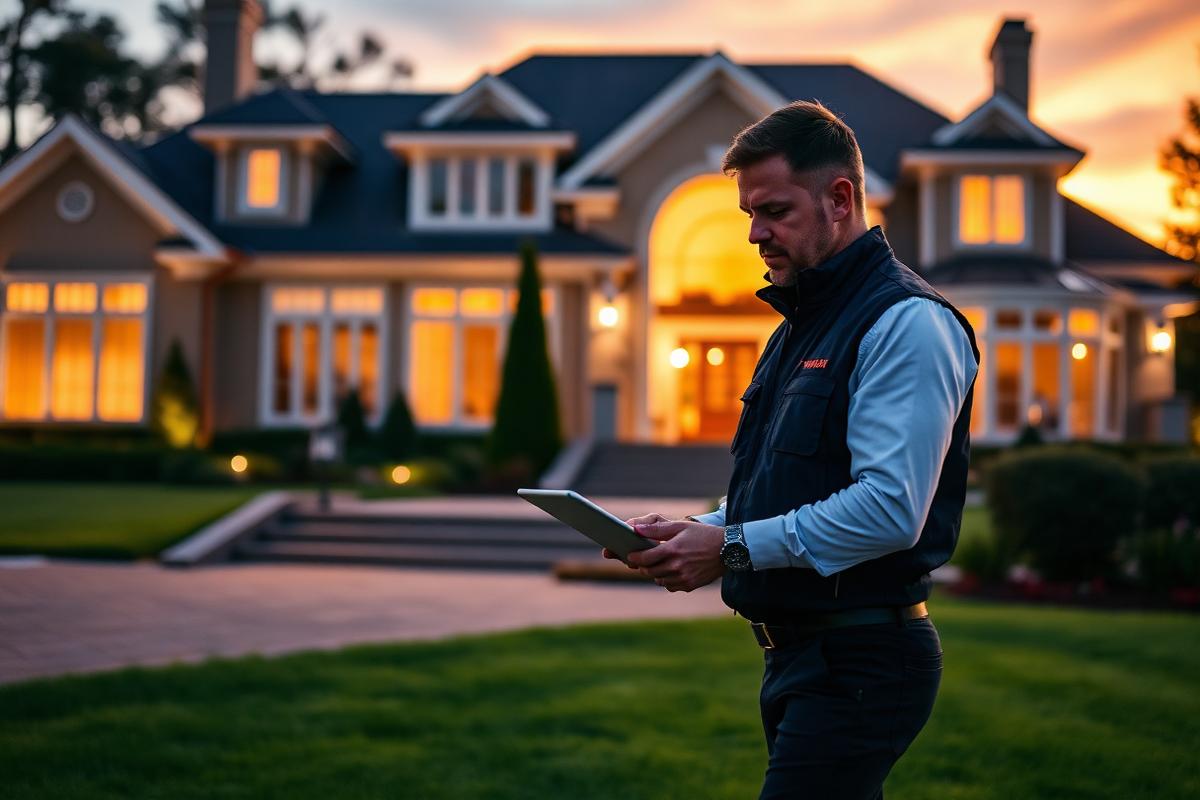
Outdoor security lighting and decorative landscape lighting are different categories with different goals, different fixture types, and different control strategies. Most homeowners try to use one to do the other — bright security floods aimed at the front of the house substituting for landscape lighting, or decorative landscape lighting being relied on for security. Neither works well.
The right answer is to design both into the property as separate systems, each doing the job it's actually good at. This guide explains the differences and how to combine them cleanly.
What Each One Is Actually For
**Security lighting** is designed to deter intruders, illuminate intruders when they appear, and produce footage that's useful for security cameras and identification. It's bright, often motion-activated, and triggered on demand. It does not need to look attractive, doesn't run continuously, and is typically aimed at perimeter approaches (side yards, rear yards, ground-floor windows, back doors).
**Landscape lighting** is designed to make the property look intentional and inviting after dark. It's soft, runs continuously during evening hours, and is aimed at architectural and landscape features (facades, trees, paths, accents). It does not provide useful security deterrence (intruders aren't deterred by soft warm-white path lights), and it's not bright enough to support useful security camera footage.
Trying to do both jobs with one system fails both jobs. Bright security floods aimed at the front of the home destroy the aesthetic and look defensive rather than welcoming. Soft warm-white landscape lighting in the rear yard provides no real security benefit when motion sensors and bright targeted lighting would.
Where Each One Belongs
The clean split for most residential properties:
**Front yard:** landscape lighting only. Facade up-lighting, tree up-lights, path lighting, accent on focal features. Soft, designed, continuous evening operation. No bright floods aimed at the home.
**Side yards:** primarily security lighting. Motion-activated fixtures at gate entrances, along narrow side passages, and at any ground-floor window facing the side yard. Some accent landscape lighting if the side yard is visible from neighbors or street.
**Back yard:** layered. Decorative landscape lighting for the patio, pool, outdoor living areas. Motion-activated security lighting on the back of the house, at back doors, and aimed at perimeter approaches from neighboring properties. Both systems run independently.
**Driveway:** primarily landscape lighting, with motion-activated security lighting at the garage face and any side access points.
The principle is that the parts of the property visible to neighbors, guests, and the street should read as designed (landscape lighting), while the parts that face perimeter risk (side and rear) should have motion-activated security lighting on demand.
Why Bright Floods Hurt Both Jobs
The cheap, default approach is to install one or two bright dusk-to-dawn floodlights aimed at the front of the house. This is the worst possible outdoor lighting decision for almost every reason:
- It's not effective security — always-on bright floods are background; intruders aren't deterred by them - It destroys the aesthetic — bright cool-white floods make the home look like a defensive bunker - It contributes to light pollution and angers neighbors - It washes out any actual landscape lighting that might be present - It's the single biggest 'amateur' tell in residential outdoor lighting
The correct security lighting equivalent is motion-activated fixtures aimed at perimeter approaches (not at the home's front), triggered only when motion is detected, integrated with a security camera system if available. Continuous always-on bright lighting is not security lighting; it's just aggressive lighting.
Motion-Activated Security: How to Spec It
For motion-activated security lighting, the right specifications are:
- Brightness: 700–2000 lumens per fixture (bright enough to illuminate intruders and provide camera footage, not so bright it ruins night vision) - Color temperature: 3000–4000K (cooler than landscape lighting to clearly signal 'security' visual category; supports color-accurate camera footage) - Sensor: PIR (passive infrared) motion sensor with adjustable sensitivity and range; ideally also integrating with smart home or camera system - Coverage: 180-degree detection angle with adjustable range of 20–50 feet - Mounting: 8–12 feet above grade for best motion detection and intruder illumination
Avoid solar motion-activated lighting for primary security applications — battery life on solar fixtures degrades to the point of unreliability within 2–3 years. Use wired (12V or line-voltage) fixtures for any security application that actually matters.
Integration With Cameras and Smart Home
Modern security lighting works best when integrated with cameras and smart-home systems. A motion-activated security light that also triggers a camera recording, sends a phone notification, and turns on adjacent zone lighting is dramatically more useful than a stand-alone fixture.
Most major security camera systems (Ring, Nest, Arlo, Eufy) support integration with smart-home platforms (Apple Home, Google Home, Alexa) that let you tie lighting actions to motion events. Spend the extra hour configuring this when the system is installed and the resulting workflow is meaningfully more useful.
Always-On Low-Level Security Lighting
There's one exception to the 'security lighting should be motion-activated' rule: low-level always-on perimeter lighting that supports both security and way-finding. This is usually small wall-mounted fixtures at every exterior door, low bollards along rear walkways, and dim path lights along the perimeter of the property.
This category overlaps significantly with landscape lighting and is usually best executed as part of the landscape lighting system rather than as a separate security install. The fixtures are landscape-grade brass at 2700K, the wattage is low (1–4 watts per fixture), and the operation is dusk-to-dawn or until midnight. They provide enough ambient perimeter visibility to identify intruders or movement without being bright enough to feel defensive.
Costs and Priorities
Budget separately for the two systems. For a typical residential property:
- Landscape lighting: $5,000–$15,000 installed for a quality residential design - Security lighting: $1,500–$4,000 installed for 4–8 motion-activated fixtures with smart integration
Total combined budget for a layered design: $7,000–$20,000. Compare to the typical $200 'security' kit from a big-box store that does neither job well — the cost difference is meaningful, the result difference is not comparable.
When Security Lighting Is the Higher Priority
For some properties, security lighting is the higher priority than landscape lighting. Homes in higher-crime areas, properties with multiple street-facing approaches, properties with significant valuables visible, or homes that the owners frequently leave vacant for extended periods all benefit from security-first design.
In those cases, get the security system right first — motion-activated perimeter lighting integrated with cameras, smart notifications, and remote control — and then layer in landscape lighting around it as budget allows. The opposite order (decorative first, security as an afterthought) tends to produce systems where the decorative lighting actively interferes with the security function.
Key takeaways
- What Each One Is Actually For
- Where Each One Belongs
- Why Bright Floods Hurt Both Jobs
- Motion-Activated Security: How to Spec It
- Integration With Cameras and Smart Home
Frequently asked
- What's the takeaway from "Outdoor Security Lighting vs Landscape Lighting: Use Both, Not One"?
- Why outdoor security lighting and decorative landscape lighting serve different purposes, and how to design both into a single residential property without conflict.
- Do you install outdoor lighting nationwide?
- Yes — across 30+ states and growing. Browse the locations directory for your city.
Related services
Featured service areas
Keep reading
How to Choose Landscape Lighting Fixtures That Last 10+ Years
A homeowner's guide to picking outdoor landscape lighting fixtures, transformers, bulbs, and wiring that survive a decade outside without fading, corroding, or failing.
Permanent Holiday Lighting Cost, Pros and Cons (2025 Buyer's Guide)
Permanent holiday lighting (Trimlight, Jellyfish, Everlights) explained: real installation cost, how it works, warranty red flags, and the questions to ask before you sign.