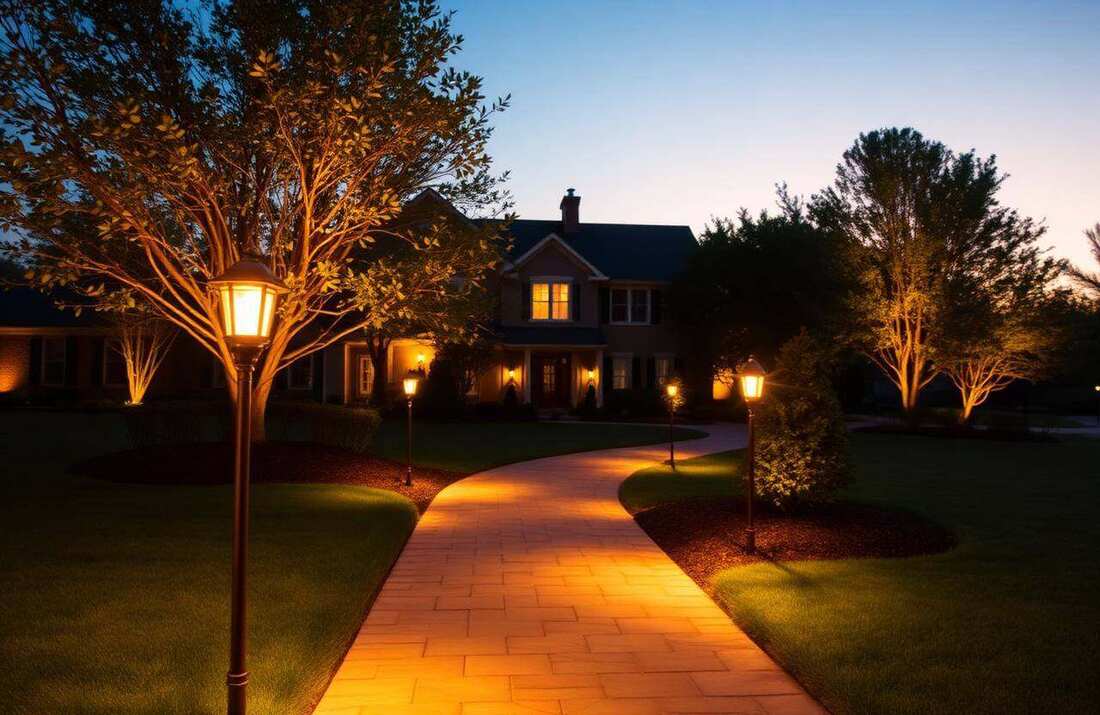
A single well-lit tree can carry an entire front yard. The right up-lighting turns an ordinary maple into the dominant nighttime feature of a property — and the same tree, lit wrong, just looks like someone forgot to turn off a flashlight in the lawn. The difference is technique, not budget.
This guide covers exactly how landscape designers approach tree up-lighting: where to place fixtures, what beam angle to choose, how much wattage to use, and the small details that separate amateur installs from designed ones.
Start with the Tree's Architecture, Not Its Trunk
Every up-lighting design starts the same way: walk around the tree at night with a flashlight and find the angle that shows off the trunk structure and canopy shape best. Most homeowners think of a tree as a vertical cylinder and aim straight up the trunk. Designers think of a tree as a sculpture and light it from the angle that reveals the most character.
For a tree with strong branching architecture (oak, sycamore, Japanese maple), the goal is to light the trunk and lower canopy so the branch structure casts dappled shadows on itself. For a tree with soft, dense canopy (Bradford pear, ornamental cherry, magnolia), the goal is to wash the underside of the canopy with light so the whole crown glows. Each tree gets a different treatment.
Use Two or Three Fixtures, Not One
A single fixture at the base of a tree creates a harsh hot spot on one side of the trunk and a sharp shadow on the other. It almost always looks accidental. The reliable technique is two or three fixtures, placed at 90–120 degree intervals around the trunk, each aimed slightly differently.
For a small ornamental tree (under 15 feet), two 4–5 watt fixtures placed at 8 and 4 o'clock positions usually does it. For a medium shade tree (15–35 feet), three 6–8 watt fixtures at 10, 2, and 6 o'clock. For a large mature tree (35+ feet), three to five fixtures at higher wattage, with at least one positioned to wash the underside of the upper canopy.
Multiple fixtures eliminate the hot-spot-and-shadow look and let you control which sides of the trunk and canopy are emphasized. They also give you a fallback — when one fixture eventually fails, the tree still reads correctly until repair.
Match Beam Angle to Tree Size
Beam angle (also called beam spread) is measured in degrees and printed on every quality LED bulb spec sheet. The right beam for tree up-lighting depends on tree size:
- Small ornamental tree (under 15 feet): 38–60 degree beam - Medium shade tree (15–35 feet): 24–38 degree beam - Large mature tree (35+ feet): 10–24 degree beam, narrower for higher trees
Narrower beams reach higher without spilling light. Wider beams cover more of a small canopy without leaving dark edges. Picking the wrong beam is the single most common technical mistake in tree up-lighting — a 60-degree beam pointed at a 60-foot oak just lights the lower trunk and dies before it reaches the canopy.
Fixture Distance From the Trunk
Place fixtures 12–24 inches from the trunk for most trees. Closer than 12 inches and the beam shoots straight up, missing the canopy entirely and creating a harsh vertical stripe on the trunk. Farther than 24 inches and the fixture is too easy to hit with a mower, the cable run gets longer than it needs to be, and the beam is fighting through low branches.
The exception is moonlighting — large down-lights mounted high in the tree itself, aimed downward to mimic actual moonlight filtering through the canopy. Moonlighting is a different technique with different rules and is worth its own conversation with your designer.
Color Temperature: 2700K for Almost Everything
Tree up-lighting should be 2700K warm white in nearly every case. 2700K reads natural on green foliage and warm on bark. 3000K starts to feel slightly cool. 4000K and above makes foliage look gray-green and unhealthy, even on a perfectly healthy tree.
The one defensible exception is birch and other white-bark trees, where 3000K can emphasize the bark's natural cool tone for a more dramatic effect. Even there, most designers still default to 2700K because consistency across the property reads more intentional than mixing temperatures.
Hiding the Fixtures
The visible fixture is the giveaway between a designed install and an amateur one. Quality tree up-lighting fixtures are buried in mulch or low groundcover so only the lens shows, angled away from the primary viewing angle (usually the street or front entry).
Use well lights — fully recessed fixtures — when the tree is in lawn or in a high-traffic area where surface fixtures would be obvious or get damaged. Use bullet lights with low-profile stakes when the tree is in a planting bed and the fixture can be hidden by foliage.
Either way, never aim a fixture so the lens is visible from the primary viewing angle. Visitors should see the lit tree, not the lights doing the lighting.
Maintenance and Adjustment Over Time
Trees grow. A tree up-lighting design that works in year one will need adjustment by year three and again by year seven. Branches that were 12 feet up are now 18 feet up. Canopies that were 20 feet wide are now 30 feet wide. Fixtures that were perfectly positioned now point at empty air.
Plan for a re-aim visit every 2–3 years as part of normal landscape lighting maintenance. Quality installers include the first re-aim in the original price and offer subsequent visits at a flat fee. Skip those visits and the design slowly drifts out of true — the lights still work, but the magic erodes one growing season at a time.
Key takeaways
- Start with the Tree's Architecture, Not Its Trunk
- Use Two or Three Fixtures, Not One
- Match Beam Angle to Tree Size
- Fixture Distance From the Trunk
- Color Temperature: 2700K for Almost Everything
Frequently asked
- What's the takeaway from "Tree Up-Lighting: How to Light Trees Like a Landscape Designer"?
- How to up-light residential trees correctly — fixture placement, beam angle, wattage, and the techniques landscape designers use to make a single tree the focal point of a yard.
- Do you install outdoor lighting nationwide?
- Yes — across 30+ states and growing. Browse the locations directory for your city.
Related services
Featured service areas
Keep reading
How to Choose Landscape Lighting Fixtures That Last 10+ Years
A homeowner's guide to picking outdoor landscape lighting fixtures, transformers, bulbs, and wiring that survive a decade outside without fading, corroding, or failing.
Permanent Holiday Lighting Cost, Pros and Cons (2025 Buyer's Guide)
Permanent holiday lighting (Trimlight, Jellyfish, Everlights) explained: real installation cost, how it works, warranty red flags, and the questions to ask before you sign.